
Norway Rats: Why "Sewer Rat" Actually Fits
Every rat we trap in New Hope that isn't a mouse is almost always this one — Rattus norvegicus, the Norway rat. Here's how they actually live, breed, and get around, and why the "sewer rat" nickname isn't just a scary rumor.
Norway Rat Biology, At a Glance
That reproductive speed is the whole reason "we'll just wait and see" almost never works out.
Why "Norway Rat"? Why "Sewer Rat"?
Here's something that surprises most homeowners: Norway rats didn't actually come from Norway. The name stuck from an 18th-century mix-up in Europe, when people assumed the species arrived on Norwegian trading ships. In reality, Rattus norvegicus most likely originated in Asia and spread around the world on cargo ships of every flag.
The "sewer rat" nickname is a lot more accurate. Norway rats are strong swimmers, able to tread water for several days and hold their breath briefly underwater, which means sewer and storm drain systems are a natural highway for them. It's also where the (true, if unsettling) stories about a rat coming up through a toilet come from — rare, but not a myth. If you've traced activity back toward a drain or foundation gap, that's exactly what our rat removal process is built to handle.
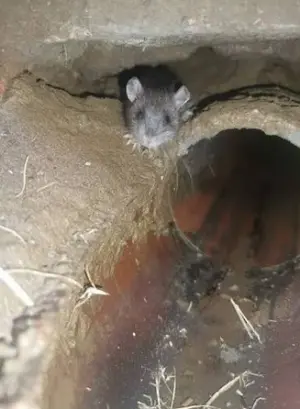 The "Sewer Rat"
How Norway Rats Actually Behave
Click through each one to see what drives their habits, not just what they look like.
- What they eat: Pretty much anything — garbage, pet food, bird seed, compost, and stored food if it's reachable. True omnivores and opportunists.
- How much: A Norway rat eats roughly its own body weight in food every few days, which is part of why a food source left out keeps a colony active instead of moving on.
- New Hope specifics: Spilled birdseed under backyard feeders and unsecured compost bins are two of the most common food sources we trace an active burrow back to.
- When they're active: Mostly nocturnal, with activity peaking right after dusk and again before dawn.
- How far they roam: Typically within 100 to 300 feet of their burrow, rarely farther unless food runs short.
- How they travel: Along the same paths night after night, which is why rub marks and grease trails show up in the exact same spot along a foundation or fence line.
- Can they climb? Not well. Norway rats stay mostly ground-level, unlike roof rats, which is one reason attic activity in New Hope is more often mice or squirrels than Norway rats.
- What a burrow looks like: A network of tunnels with multiple entrances, usually 2 to 4 inches across, dug into soft soil near a stable structure like a foundation, shed, or retaining wall.
- Why near structures: A burrow next to concrete or wood gets natural cover from predators and weather, and it's harder for a tunnel to collapse.
- Depth: Burrow systems can run several feet deep and include separate chambers for nesting, food storage, and waste, separate from the main living area.
- New Hope specifics: We find burrows most often along aging sewer and storm line routes, under sheds and decks, and in dense landscaping near older fence lines.
- Group living: Norway rats live in colonies, usually a family group sharing one burrow system rather than solitary animals.
- Hierarchy: Colonies have a loose pecking order, generally built around access to the best food and nesting spots.
- Territory: A colony defends its burrow and immediate territory from outside rats, which is part of why trapping needs to account for a group, not just the one rat you saw.
- Breeding season: Can breed year-round if conditions stay warm enough, which is more common indoors or in a well-insulated burrow than you'd think for a Minnesota winter.
- Litter size: 6 to 12 pups per litter is typical, with a new litter possible roughly every 3 weeks under good conditions.
- Maturity: Young rats reach sexual maturity in as little as 2 to 3 months, which is how a small burrow turns into a real colony in a single season.
This same math is behind the mouse-focused 5-day rule in our FAQ — rats breed on an even faster clock.
"People picture one rat. What we're usually dealing with is a burrow system with a family group inside it, which is exactly why a single trap by the back step almost never finishes the job."
— What we explain on almost every rat inspection
The Norway Rat Life Cycle
This is why acting early matters more with rats than with almost any other pest you'll deal with around the house.
Birth
A litter of 6 to 12 pups is born blind and hairless, fully dependent on the mother inside the burrow's nesting chamber.
~3 Weeks: Weaning
Pups are weaned and start eating solid food, venturing short distances from the nest for the first time.
2–3 Months: Sexual Maturity
Young rats are now capable of breeding themselves, which is the point a single burrow can start producing multiple active litters at once.
Ongoing: A New Litter Every ~3 Weeks
Under good conditions — food, shelter, warmth — breeding continues on a tight cycle, which is how a "we saw one rat" call often turns into a real colony by the time we inspect.
The earlier a burrow gets traced and sealed, the fewer of these cycles it gets to complete. See our rat removal process →
Where New Hope's Norway Rats Actually Live
Habitat isn't random. A few specific features of this city explain most of the burrow locations we find:
- Aging sewer and storm line routes. New Hope's big growth years in the 1950s and 60s left behind infrastructure that Norway rats use as both shelter and a travel corridor between properties.
- Sheds, decks, and dense landscaping. Soft soil near a stable structure, especially along older fence lines, is exactly the setup a burrow system needs.
- Northwood & Civic Center Parks. Roughly 85 acres combined of park, lake, and trail give outdoor colonies cover and water access a short trip from nearby homes.
Signs It's a Norway Rat, Specifically
These are different from general "something's in the house" signs — these point to Norway rats in particular:
Norway Rat Questions We Get a Lot
Why are they called "Norway rats" if they're not from Norway?
It's a naming mix-up from the 1700s. Europeans at the time assumed the species arrived on Norwegian trading ships, so the name stuck even though Rattus norvegicus most likely originated in Asia.
Can Norway rats really swim up through a toilet?
It's rare, but yes, it's documented. Norway rats are strong swimmers and comfortable in sewer and drain systems, which is exactly where the "sewer rat" nickname comes from. It's not a common way they get into a home, but it is a real one.
How far from their burrow do Norway rats typically travel?
Usually 100 to 300 feet, rarely farther unless food is scarce. That's part of why a burrow near your property almost always means your yard or a close neighbor's is the food source keeping it active.
Do Norway rats climb, or do they stay on the ground?
They're not strong climbers compared to roof rats or mice. Norway rats mostly stick to ground-level travel, burrows, and low wall voids, which is why attic noise in New Hope is more often mice or squirrels than this species.
How long do Norway rats live?
In the wild, usually under a year, mostly due to predators, cold, disease, and competition for food. In a sheltered environment with no threats, they can live two to three years, which is one reason an indoor colony is harder to "wait out" than people expect.
Is a "sewer rat" a different species from a Norway rat?
No — it's the same animal. "Sewer rat," "brown rat," and "house rat" are all common nicknames for Rattus norvegicus, used depending on where it's been spotted or how someone's describing it.
Norway Rat Inspections Across Our Service Area
Based in New Hope (ZIP codes 55427 and 55428), with the same species-specific approach for these surrounding communities: