
House Mice: Small Enough to Disappear Into a Dime-Sized Gap
Mus musculus is the species behind almost every mouse call we get in New Hope. Here's how they actually move, nest, and breed, and why a mouse problem can grow a lot faster than most homeowners expect.
House Mouse Biology, At a Glance
That combination — fast breeding, tiny entry requirements — is why "it's just one mouse" rarely stays true for long.
Why House Mice Live With Us, Not Just Near Us
Unlike a lot of wildlife, house mice didn't just wander into human spaces by accident. Mus musculus has lived alongside people for thousands of years, likely since early grain farming gave them a reliable, year-round food source. Over time, they became genuinely dependent on buildings for shelter, not just visitors passing through.
That history is exactly why a house mouse problem rarely "moves on" the way an outdoor animal might. Once one finds a gap into a warm New Hope home with food nearby, it's found exactly the environment it evolved to use. Sealing that gap for good is what our exclusion & sealing service is built around.
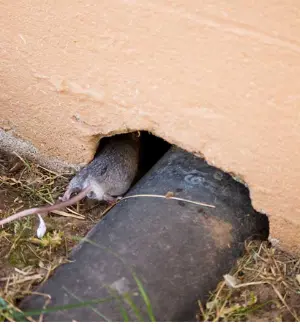 All It Takes
How House Mice Actually Behave
Click through each one to see what drives their habits, not just what they look like.
- What they eat: Grains, seeds, and pet food are preferred, but house mice will eat almost anything available, including pantry staples in cardboard or thin plastic packaging.
- How much: Surprisingly little — a mouse only needs a few grams of food a day, which is part of why a small, hidden pantry stash can support activity for weeks before anyone notices.
- New Hope specifics: Cereal boxes, bread bags, and open pet food containers are the most common food sources we trace an active kitchen problem back to.
See our mouse removal process for how we trace activity back to the food source.
- Can they climb? Yes, and well. Unlike Norway rats, house mice climb rough vertical surfaces easily, which is exactly how they end up in attics, upper cabinets, and wall voids far from ground level.
- How they travel: Along the same routes night after night, usually within 10 to 30 feet of the nest, rarely ranging far if food stays available.
- When they're active: Nocturnal, with most activity happening after dark, though a heavy infestation can show some daytime movement too.
- Jumping & squeezing: A house mouse can jump roughly a foot straight up and flatten its body to fit through gaps barely wider than a pencil.
Norway rats move very differently — see our Norway rat behavior guide for the comparison.
- Materials used: Shredded paper, insulation, fabric, and anything else soft and gatherable, packed into a hidden, sheltered spot.
- Where nests show up: Wall voids, attic insulation, behind appliances, and inside stored boxes are the most common spots we find in New Hope homes.
- Why it matters: A nest means the mouse has settled in, not just passed through, and it's usually close to wherever the droppings and chewed material are concentrated.
Nesting damage to insulation is covered in more detail on our property damage guide.
- Eyesight: Poor, and mice can't see color well at all. They rely far more on smell, hearing, and their whiskers than on vision.
- Whiskers: Used to feel out a space in the dark, which is why mice almost always travel along walls and edges rather than cutting across open floor.
- Hearing: Excellent, and tuned to a wider range than human hearing, including some ultrasonic squeaks mice use to communicate with each other.
- Smell: Extremely sharp, strong enough to detect food sources and other mice from a notable distance.
Our identification guide covers how these senses translate into the sounds you actually hear.
- Breeding season: Can breed year-round indoors, since a warm New Hope home removes the seasonal limits an outdoor mouse would face.
- Litter size: 4 to 12 pups, with a new litter possible roughly every 3 weeks under good conditions.
- Maturity: As fast as 6 weeks, which is quicker than almost any other common household pest.
This is the exact math behind our 5-day mouse rule FAQ — one mouse rarely stays one mouse for long.
"The question isn't whether a mouse can climb into your attic. It's whether there's a gap for it to start from. Find that gap, and you've solved the problem for good, not just for a week."
— What we tell homeowners on almost every mouse inspection
The House Mouse Life Cycle
This is why a mouse problem can outrun a slow response faster than almost anything else in the house.
Birth
A litter of 4 to 12 pups is born blind, hairless, and fully dependent, tucked into a nest built from whatever soft material was available.
~3 Weeks: Weaning
Pups are weaned and begin exploring short distances from the nest, following the same scent trails adult mice already use.
~6 Weeks: Sexual Maturity
Young mice are now capable of breeding themselves — one of the fastest paths to maturity of any common household pest.
Ongoing: A New Litter Every ~3 Weeks
With food, warmth, and shelter available, breeding continues on a tight cycle, which is how "we heard one scratch" turns into real activity within a month or two.
The earlier the entry point gets sealed, the fewer of these cycles it gets to complete. See our mouse removal process →
Why New Hope Homes Are Such Easy Targets
A few things specific to this city explain why house mice find their way in as often as they do:
- Original vent screens on 1950s–60s ramblers. A lot of New Hope's housing stock still has its original attic and foundation vent screens, and decades of wear leave gaps well within a mouse's reach. Sealing these for good is the long-term fix.
- Attached garages. A common layout here, and one that gives mice a sheltered, less-trafficked space to nest in before working their way into the living area through a shared wall or door gap.
- Boxes moved in from outdoor storage. Holiday decorations and seasonal items stored in a garage or shed sometimes carry a nest inside without anyone noticing until it's unpacked indoors, often with the kind of insulation and fabric nesting damage described on our property damage page.
Signs It's a House Mouse, Specifically
These point to house mice in particular, not just "something's in the house":
House Mouse Questions We Get a Lot
Can house mice see color?
Not really. Their eyesight is poor overall, and color vision is especially limited. Mice rely much more on smell, hearing, and their whiskers to navigate than on what they can see.
Why do house mice squeak at night?
Mice communicate with each other using sounds, including some pitched too high for people to hear without equipment. The squeaking you can actually hear usually means activity close by, often during feeding, fighting over territory, or a mother with a nearby litter.
Do house mice really only need a dime-sized hole to get in?
Yes. A house mouse can flatten its body and squeeze through a gap about a quarter-inch wide, roughly the size of a dime. That's smaller than most people assume, which is exactly why a "small" gap around a pipe or vent is still worth sealing.
How many house mice usually live together?
More than people expect. Mice don't live as solitary as many assume — a single nest commonly supports several mice, and because breeding happens so fast, that number can climb quickly if the entry point stays open.
Can house mice survive outdoors through a Minnesota winter?
Some do, but it's hard on them, and most that can find a way inside will take it. That's a big part of why fall is our busiest season for mouse calls — outdoor conditions get harder right as an easy indoor option becomes available.
Do house mice bite people?
It's rare, and usually only happens if a mouse feels cornered or is being directly handled. Most mouse activity in a home involves no direct contact with people at all, which is part of why droppings and chewed packaging are the signs people actually notice first.
House Mouse Inspections Across Our Service Area
Based in New Hope (ZIP codes 55427 and 55428), with the same species-specific approach for these surrounding communities: